Here is the blog I am keeping up for Abby's ceramics class if anyone was interested. It is mostly research, but you might get a few ideas, who knows :)
http://robinzclayblu.blogspot.com/
Monday, October 12, 2009

In response to comments...
I have a good number of these animals, some of them are in color, and some are in B+W, but the ones in color can easily become greyscale. I also tried a more conventional paint by number type of design, and wonder if I should convert some/all of these animals to this kind of design?
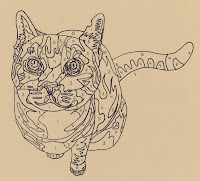
At this point, I'm thinking it would be a sort of coloring book, mayhaps with a built in story, or some sort of caption for each print. I have seen this style before in coloring books (yes I still color :P), and it couldbe an interesting way to meld the two ideas togehter.
thoughts?

At this point, I'm thinking it would be a sort of coloring book, mayhaps with a built in story, or some sort of caption for each print. I have seen this style before in coloring books (yes I still color :P), and it couldbe an interesting way to meld the two ideas togehter.
thoughts?
Wednesday, October 7, 2009
Current Idea
I started out thinking about What I was making for my book, and having had a certain song stuck in my head, I originally thought about finding a song filled with profanity and illustrating a children's book using the lyrics form the song. I planned on making the pages plush, like a baby book, and the illustrations childish. I planned on using the "I'm on a boat" song, but later decided that I did not want to use someone else's lyrics.
The new Idea I had was based off of the multiple drawings I have been doing lately, found at my deviantArt site, which are broken down into more simple shapes, easily converted into a pain/color by number. I love the idea of using these sketches that have no place other than my sketchbook as of now, and I want tot bring in the hand drawn quality to the digital print, but I need to develop the idea further.
I'm open to suggestions, and am looking for a new direction to take this idea, so untill then, sayounara minnasan!

The new Idea I had was based off of the multiple drawings I have been doing lately, found at my deviantArt site, which are broken down into more simple shapes, easily converted into a pain/color by number. I love the idea of using these sketches that have no place other than my sketchbook as of now, and I want tot bring in the hand drawn quality to the digital print, but I need to develop the idea further.
I'm open to suggestions, and am looking for a new direction to take this idea, so untill then, sayounara minnasan!

Some book research I did..
Some examples of books that go beyond books. These examples are found from exhibit pictures so there's not a lot of info on the artist. I will try to find more info and make another post later.
Robert The
Afterjoyce

Paul Johnson
Manchester, United Kingdom
Is this the House in a Tree I Saw so Clearly as a Child?
Dyed and cut engineered paper

Carol Barton
Nexus Press
Atlanta, Georgia
Instructions for Assembly
Printed pages, engineered paper

40 Poems
handmade artist book
16"h x 14"w
by Barbara Brown

Robert The
Afterjoyce

Paul Johnson
Manchester, United Kingdom
Is this the House in a Tree I Saw so Clearly as a Child?
Dyed and cut engineered paper

Carol Barton
Nexus Press
Atlanta, Georgia
Instructions for Assembly
Printed pages, engineered paper

40 Poems
handmade artist book
16"h x 14"w
by Barbara Brown

Sunday, October 4, 2009
progress
While I did this first part earlier last week, I did not post so I figured i would drop an update while I was on the computer.
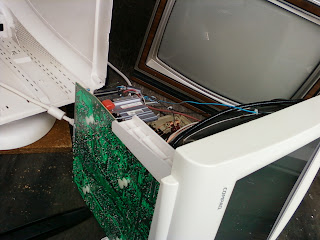
There happens to be a recycling drop off point near to my apartment, and one of the bins is for electronics. Wishing for a little extra pizzaz to add to my final print, I went in to salvage some of the cooler-looking parts :P
Mid way through dismantling a broken monitor, the recycling company's truck pulled up... I was kinda worried I wasn't supposed to be there, as there is a giant sign that says, "THIS AREA IS UNDER VIDEO SURVEILLANCE" turns out he laughed and thought I was salvaging parts to build my own computer. He had no problem with me being there, and I went back to work.
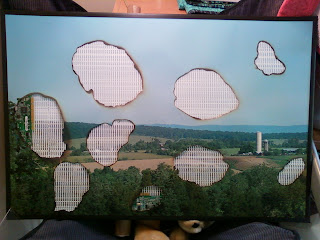
After I got my images printed, I went pyro on the full picture, burning holes to make it appear as though the technology is burning through.
Some of the thought I have had while creating this idea:
-anything can be reproduced through technology
-computer took a scene with little to no technology and made it into bits of data/information
-even those who seek to remove themselves from technology are subject to becoming a part of it
-what happens to the world when technology takes over? Maybe we have so many movies and books about robots taking over is because there is some basis in truth o.O
-Though I can't recall the title I read a book in my childhood about the development of a virtual reality system that allowed the user to go/do whatever they wished without moving from the stasis pod their body rested in. The world eventually falls apart because all the people end up liking the pods better than real life. One boy is left alone on the planet as it collapses around him and the people in the pods start dying off because there is no one around to take care of them
There happens to be a recycling drop off point near to my apartment, and one of the bins is for electronics. Wishing for a little extra pizzaz to add to my final print, I went in to salvage some of the cooler-looking parts :P
Mid way through dismantling a broken monitor, the recycling company's truck pulled up... I was kinda worried I wasn't supposed to be there, as there is a giant sign that says, "THIS AREA IS UNDER VIDEO SURVEILLANCE" turns out he laughed and thought I was salvaging parts to build my own computer. He had no problem with me being there, and I went back to work.

After I got my images printed, I went pyro on the full picture, burning holes to make it appear as though the technology is burning through.

Some of the thought I have had while creating this idea:
-anything can be reproduced through technology
-computer took a scene with little to no technology and made it into bits of data/information
-even those who seek to remove themselves from technology are subject to becoming a part of it
-what happens to the world when technology takes over? Maybe we have so many movies and books about robots taking over is because there is some basis in truth o.O
-Though I can't recall the title I read a book in my childhood about the development of a virtual reality system that allowed the user to go/do whatever they wished without moving from the stasis pod their body rested in. The world eventually falls apart because all the people end up liking the pods better than real life. One boy is left alone on the planet as it collapses around him and the people in the pods start dying off because there is no one around to take care of them
Friday, September 25, 2009
artists using text
while I continue to work on my project (which I am printing at home), I paid my daily visit to TeeFury to see what was up for the day. The design has a lot to say about politics, and though I will not be getting one, I thought it was worth sharing.

~Robin

~Robin
Monday, September 21, 2009
An Artist who uses text
...and yes, this IS my own research. So sorry to have gotten your hopes up before.
Mark Tobey
Tobey is most famous for his creation of so-called "white writing" - an overlay of white or light-colored calligraphic symbols on an abstract field which is often itself composed of thousands of small and interwoven brush strokes. This method, in turn, gave rise to the type of "all-over" painting style made most famous by Jackson Pollock, another American painter to whom Tobey is often compared. [10]
Tobey’s work is also defined as creating a vibratory space with the multiple degrees of mobility obtained by the Brownian movement of a light brush on a bottom with the dense tonalities. The series of “Broadway” realized at that time has a historical value of reference today. It precedes a new dimension of the pictorial vision, that of contemplation in the action.
His work is inspired by a personal belief system that suggests Oriental influences and reference to Tobey's involvement in the Bahá'í Faith. Four of Tobey's signed lithographs hang in the reception hall in the Seat of the Universal House of Justice, the supreme governing institution of the Baha’i Faith.
At least 5 of his works are in the permanent collections of the Museum of Northwest Art. Tobey's work can be found in most major museums in the U.S. and internationally, including the Smithsonian American Art Museum, the Tate Gallery in London, the Museum of Modern Art in New York, the Metropolitan Museum of Art, and the Whitney Museum of American Art.


The art of Mark Tobey, with his calligraphic “white writing,” is sometimes taken as a precursor of gestural abstraction in New York. And the case for linking some forms of Abstract Expressionism with Asian writing has been made and unmade many times. With its lineup of Pollocks, Motherwells and Klines, the show pushes it forward again, though without adding anything startlingly new to the argument.
Mark Tobey
Tobey is most famous for his creation of so-called "white writing" - an overlay of white or light-colored calligraphic symbols on an abstract field which is often itself composed of thousands of small and interwoven brush strokes. This method, in turn, gave rise to the type of "all-over" painting style made most famous by Jackson Pollock, another American painter to whom Tobey is often compared. [10]
Tobey’s work is also defined as creating a vibratory space with the multiple degrees of mobility obtained by the Brownian movement of a light brush on a bottom with the dense tonalities. The series of “Broadway” realized at that time has a historical value of reference today. It precedes a new dimension of the pictorial vision, that of contemplation in the action.
His work is inspired by a personal belief system that suggests Oriental influences and reference to Tobey's involvement in the Bahá'í Faith. Four of Tobey's signed lithographs hang in the reception hall in the Seat of the Universal House of Justice, the supreme governing institution of the Baha’i Faith.
At least 5 of his works are in the permanent collections of the Museum of Northwest Art. Tobey's work can be found in most major museums in the U.S. and internationally, including the Smithsonian American Art Museum, the Tate Gallery in London, the Museum of Modern Art in New York, the Metropolitan Museum of Art, and the Whitney Museum of American Art.


The art of Mark Tobey, with his calligraphic “white writing,” is sometimes taken as a precursor of gestural abstraction in New York. And the case for linking some forms of Abstract Expressionism with Asian writing has been made and unmade many times. With its lineup of Pollocks, Motherwells and Klines, the show pushes it forward again, though without adding anything startlingly new to the argument.
Subscribe to:
Posts (Atom)